






THE SCANDAL OF THE CENTURY IN MEDICINE!
THE DECEPTION OF PAXIL STUDY 329 REVEALED AFTER 24 YEARS
Prof. Dr. F. Cankat Tulunay
www.klinikfarmakoloji.com
Modern pharmacology is regarded as one of the most powerful tools of evidence-based medicine. However, several examples that have emerged over the past three decades demonstrate that clinical research is subject not only to methodological limitations but also to serious issues related to data analysis, reporting, and publication processes. In this context, the case of Study 329 related to paroxetine (Paxil) stands out as one of the most striking examples of corruption in the pharmacological literature. As I have emphasized in my previous work, the problem is not merely the publication of a flawed study; rather, the real issue is that such a study continues to exist in the literature for years and continues to influence clinical decision-making (http://www.klinikfarmakoloji.com/search/node?keys=paxil)
A Pharmalot column published in STAT News on April 15, 2026, addresses a long-standing controversy regarding the antidepressant Paxil (active ingredient: paroxetine): the 2001 study known as “Study 329.” The article emphasizes that this study can still be read today with a “hidden warning” and describes the situation as “hiding in plain sight.” The study in question is: Keller MB, Ryan ND, Strober M, et al. Efficacy of paroxetine in the treatment of adolescent major depression: a randomized, controlled trial. J Am Acad Child Adolesc Psychiatry 2001;40:762–772.
The relationships between the authors of Study 329 and the pharmaceutical industry, as well as the sponsored nature of the study, have been widely discussed in the literature. In particular, evidence that medical writers were involved in the preparation of the manuscript raises significant ethical concerns regarding academic authorship and independence in data interpretation. This highlights that in clinical research, not only the results themselves but also how those results are generated and presented must be critically evaluated. Another dimension of the scandal is that the article was not written by the listed authors but by a ghostwriter named Sally Laden.
The Journal of the American Academy of Child & Adolescent Psychiatry (JAACAP) placed an “Expression of Concern” on this 24-year-old study in the fall of 2025. This indicates that the journal acknowledges the possibility of errors or unreliable information in the study. Despite this warning urging readers to interpret the article with caution, the paper has not been retracted. The article has effectively become a “zombie” publication. A “zombie clinical study” refers to research that has been scientifically discredited but continues to exist in the literature.
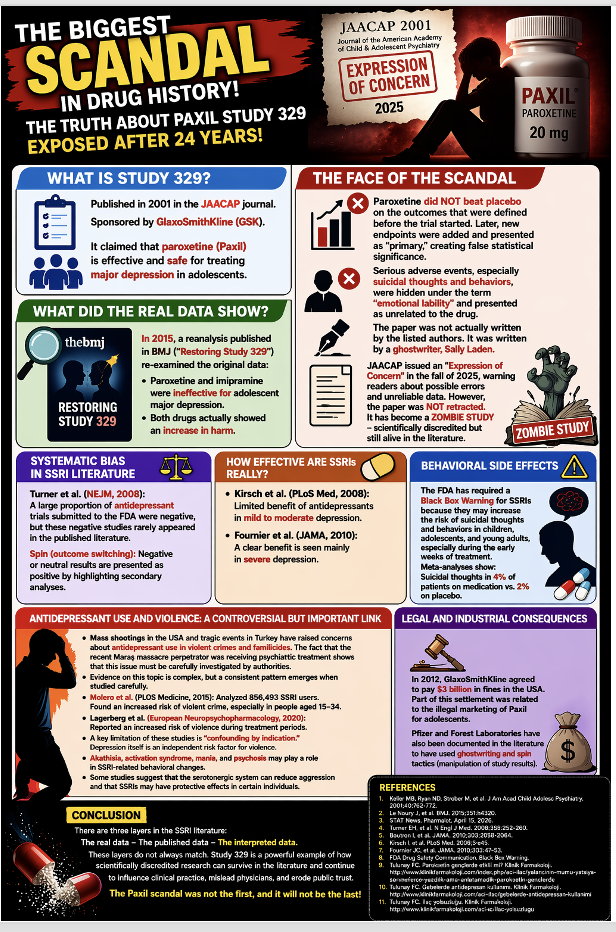
Study 329 was published in JAACAP in 2001, conducted under the sponsorship of GlaxoSmithKline, and claimed that paroxetine was effective and safe for the treatment of major depression in adolescents. This study became one of the key pieces of evidence used by GSK to market Paxil for adolescent use. However, substantial criticism has emerged over the years.
In the original publication, although paroxetine failed to show superiority over placebo in the pre-specified primary endpoints, new endpoints were introduced in the published version and presented as “primary,” thereby creating an illusion of statistical significance. More importantly, serious adverse events—particularly suicidal ideation and behavior—were categorized under the term “emotional lability” and presented as unrelated to the drug.
The 2015 reanalysis titled “Restoring Study 329,” published in The BMJ, clearly exposed these issues. In this reanalysis by Le Noury and colleagues, both paroxetine and imipramine were found to be ineffective in adolescent major depression, and both drugs were associated with increased harm. This study represents a critical turning point in the history of clinical research, as it demonstrated conclusions completely opposite to those of the original publication.
When the SSRI literature is examined more broadly, it becomes clear that this issue is not limited to paroxetine. The study by Turner et al., published in the New England Journal of Medicine, showed that a significant proportion of antidepressant trials submitted to the FDA had negative results, yet these studies were largely absent from the published literature. The non-publication of negative trials or their presentation as positive creates systematic bias in the literature.
At this point, the phenomenon of “spin” comes into play. Negative or neutral results are presented as positive by emphasizing secondary analyses, directly influencing clinical practice. This demonstrates that the interpretation of data, rather than the data itself, often determines the conclusions drawn.
Meta-analyses on the efficacy of SSRIs support this perspective. Analyses based on FDA data by Kirsch and colleagues indicate that antidepressant effects are limited, particularly in mild to moderate depression. Similarly, the study by Fournier et al., published in JAMA, showed that the benefits of antidepressants are mainly observed in severe depression.
One of the most controversial aspects of SSRIs is their behavioral side effects. The FDA has issued a “black box warning” stating that antidepressants may increase suicidal thoughts and behaviors in children and young adults, particularly during the early phases of treatment. Meta-analyses indicate that suicidal ideation occurs in approximately 4% of patients receiving medication compared to 2% in the placebo group.
Antidepressant Use and Violence: A Controversial but Important Issue
School shootings in the United States and, more recently, brutal murders and familicides observed in Turkey have brought antidepressant use into scientific discussion. The fact that the perpetrator of the recent Maraş massacre was receiving psychiatric treatment underscores the importance of carefully investigating this issue.
This relationship is one of the most debated topics in psychiatric pharmacology. While the evidence is conflicting, a consistent pattern emerges when examined carefully.
The most comprehensive data come from Swedish national registry studies. In a cohort study by Molero et al. (PLOS Medicine, 2015), which examined 856,493 individuals using SSRIs, violent crime convictions during treatment periods were compared with non-treatment periods. Within-individual analyses showed statistically significant increases in hazard ratios, particularly in the 15–24 and 25–34 age groups (HR 1.19 and 1.16, respectively), while no significant association was found in individuals over 35.
In another study by Lagerberg et al. (European Neuropsychopharmacology, 2020), involving 785,337 individuals with 5,707,293 person-years of follow-up, 32,203 violent crime cases were identified. Within-individual analyses showed a significantly increased risk of violence during treatment periods (HR 1.26; 95% CI 1.19–1.34), which persisted for up to 12 weeks after discontinuation. However, the authors emphasized that only 2.6% of SSRI users were included in the analysis, and 97% of users did not commit any violent crimes.
A critical methodological limitation of these studies is “confounding by indication.” Depression itself is associated with violence, and one Swedish study found a threefold increase in the odds of violent crime among individuals with depression compared to the general population. It is therefore extremely difficult to distinguish whether the increased risk is due to the medication or the underlying psychiatric condition.
Akathisia (inner restlessness) is another important factor. SSRIs can cause extrapyramidal side effects and akathisia, possibly due to serotonergic inhibition of dopaminergic pathways. If unrecognized, akathisia can lead to severe distress, suicidal ideation, and even violent behavior.
The FDA’s 2004 black box warning revision included symptoms such as anxiety, agitation, irritability, hostility, aggression, impulsivity, akathisia, hypomania, and mania. Although not explicitly labeled as “violence,” these behavioral changes are clinically relevant.
The activation syndrome observed particularly in children and adolescents—characterized by impulsivity, restlessness, and insomnia—is significantly more common with antidepressants than with placebo.
SSRIs may also trigger mania or psychosis in undiagnosed bipolar patients. Emotional disinhibition and manic or psychotic reactions may create a substrate for violent behavior.
The association appears strongest in individuals aged 15–34, while statistical significance diminishes after age 35.
Legal and Industrial Aspects
In 2012, GlaxoSmithKline reached a $3 billion settlement with the U.S. Department of Justice, part of which was related to the off-label marketing of Paxil in adolescents. A lawsuit filed in 2025 also argued that the continued publication of this study was misleading to consumers.
Similar problems have been identified in other antidepressant literature. Pfizer’s ghostwriting program for Zoloft and issues in the CIT-MD-18 study conducted by Forest Laboratories are well documented.
Conclusion
The SSRI literature reveals three layers:
- The real data
- The published data
- The interpreted data
These layers do not always align.
Study 329 and similar cases demonstrate that the crisis of trust in pharmacology arises not only from flawed studies, but from the persistence of such studies in the literature without adequate correction.
The Paxil scandal is neither the first nor the last. Even in the most prestigious journals, misleading studies can be published by pharmaceutical companies and unethical researchers.
When “retracted” is searched in PubMed, thousands of retracted publications appear. A 2022 study in the Journal of Korean Medical Science examining retracted publications from Turkey identified 86 such articles and analyzed the reasons for their retraction. Unfortunately, some of these publications were used for academic promotion and even received financial support.
The crisis of trust in science and pharmacology stems not only from the existence of flawed studies, but from the failure to adequately identify and remove them from the literature.
REFERENCES
1. Keller MB, Ryan ND, Strober M, et al. Efficacy of paroxetine in the treatment of adolescent major depression: a randomized, controlled trial. J Am Acad Child Adolesc Psychiatry. 2001;40:762–772.
2. Le Noury J, et al. Restoring Study 329. BMJ. 2015;351:h4320.
3. STAT News. Pharmalot. 2026.
4. Turner EH, et al. Selective publication of antidepressant trials. N Engl J Med. 2008;358:252–260.
5. Boutron I, et al. Spin in reporting randomized trials. JAMA. 2010;303:2058–2064.
6. Kirsch I, et al. Initial severity and antidepressant benefits. PLoS Med. 2008;5:e45.
7. Fournier JC, et al. Antidepressant drug effects and depression severity. JAMA. 2010;303:47–53.
8. FDA Drug Safety Communication.
9. Tulunay FC. Paroksetin gençlerde etkili mi? Klinik Farmakoloji. http://www.klinikfarmakoloji.com/index.php/aci-ilac/yalancinin-mumu-yatsiya-kadar-senelerce-yazdik-ama-anlatamadik-paroksetin-genclerde
10. Tulunay FC. Gebelerde antidepresan kullanımı. Klinik Farmakoloji. http://www.klinikfarmakoloji.com/aci-ilac/gebelerde-antidepressan-kullanimi
11. Tulunay FC. İlaç yolsuzluğu. Klinik Farmakoloji. http://www.klinikfarmakoloji.com/aci-ilac/ilac-yolsuzlugu