




HOMEOPATHY: Pseudoscience
Prof. Dr. F. Cankat Tulunay
As we have written many times on these pages (http://www.klinikfarmakoloji.com/search/node?keys=homeopati), the same questions continue to arise: Why is a method with no scientific support still in use? How is a system described as “pseudoscience,” “scientifically impossible,” “placebo therapy,” “water therapy,” and even “quackery” still accepted by health authorities?
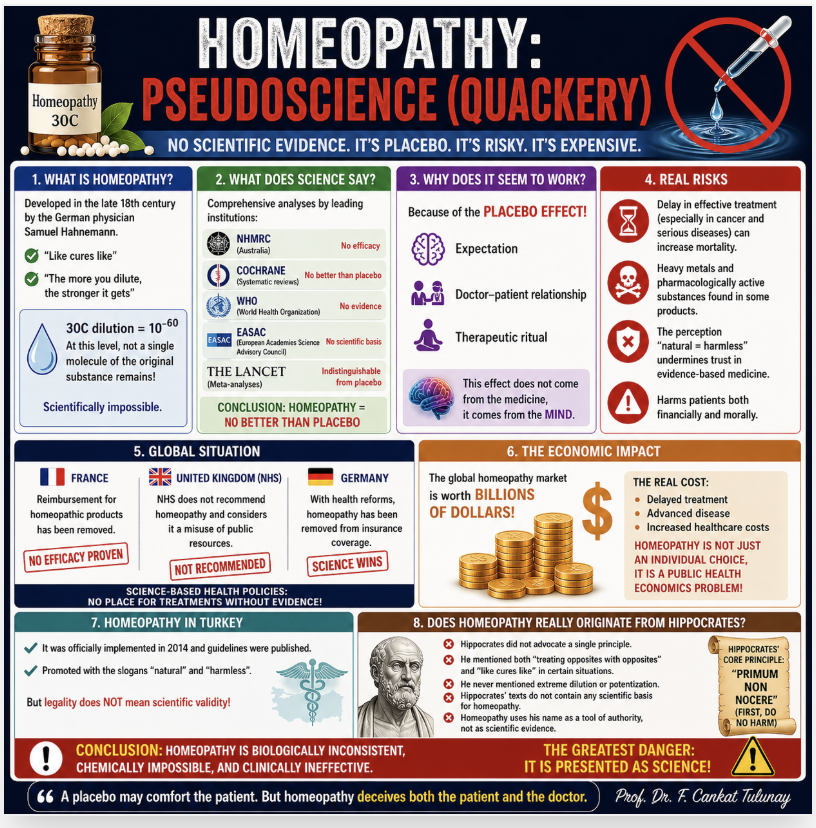
Homeopathy is a system of treatment developed in the late 18th century by the German physician Samuel Hahnemann. At the time Hahnemann lived, medicine was far from being a scientific discipline; bloodletting, toxic substances, and harmful interventions were common. In this context, homeopathy emerged as a reaction to an already flawed medical system. However, there is a fundamental reality: a system developed in response to a flawed medicine cannot automatically be correct. Historical context is not evidence of scientific validity.
Homeopathy is based on two fundamental principles: “like cures like” and the claim that substances become more potent as they are increasingly diluted. Homeopathic preparations are typically produced at dilutions such as 30C, corresponding to approximately 10⁻⁶⁰. At this level, not a single molecule of the original substance remains. This can be mathematically explained by Avogadro’s number (1). At this point, the relevant question is no longer “does it work?” but rather “is it even possible for it to work?”
Proponents of homeopathy attempt to resolve this contradiction through the concept of “water memory.” However, this hypothesis has not been scientifically validated and is considered a fabrication lacking empirical support (2).
Clinical evidence confirms this theoretical impossibility. Evaluations by NHMRC, Cochrane analyses, WHO, and EASAC reports demonstrate that homeopathy shows no reliable efficacy in any disease (3–5). Meta-analyses published in The Lancet have also shown that the effects of homeopathy are indistinguishable from placebo (6).
The reason homeopathy appears effective is the placebo effect. Expectation, therapeutic ritual, and the doctor–patient relationship can produce real biological responses (7). The critical distinction, however, is that this effect arises not from the substance itself, but from the context.
The problem with homeopathy is not merely its lack of efficacy. The greater issue lies in the clinical and ethical risks it creates. Delays in effective treatment can increase mortality, especially in cancer and serious diseases (8). Additionally, some homeopathic products have been found to contain heavy metals and pharmacologically active substances (9). The perception that “natural means harmless” undermines trust in evidence-based medicine.
The economic dimension is equally critical. The global homeopathy market has reached a multi-billion-dollar scale (10). However, the real cost is indirect: delayed treatment, advanced disease stages, and increased healthcare expenditures. Homeopathy is therefore not merely an individual choice but a healthcare economics problem.
France has removed reimbursement (11), the NHS does not recommend homeopathy (12), and in Germany serious debates have emerged, with homeopathy being removed from insurance coverage (13). Across Europe, the approach to homeopathy is becoming increasingly science-based. One of the most striking examples is Germany, where a comprehensive healthcare reform aims to close a multi-billion-euro deficit while also questioning expenditures on non-scientific treatments. The German Bundesrat is expected to vote on these reforms before the summer break. This development is not merely economic; it reflects a deeper question: should healthcare systems continue to finance treatments without proven efficacy? In Germany, the answer is increasingly clear: no.
The reassessment of a system that has existed for over 230 years reflects the tension between science and tradition. This is not only a cost-saving measure but also a repositioning of healthcare policies on a scientific foundation. Allocating limited healthcare resources to placebo-level treatments is not only an economic issue but also an ethical one.
This inevitably raises a broader question: if a country with a strong scientific infrastructure such as Germany removes homeopathy from insurance coverage, what should be the position of other countries?
Homeopathy in Turkey
In Turkey, homeopathy exists within a legal framework. However, legality does not imply scientific validity. Practices are often presented under the rhetoric of “natural,” “harmless,” and “personalized treatment.” Combined with economic pressures and patient expectations, this situation may lead some physicians to adopt such practices.
While many countries have concluded that homeopathy is not a valid treatment and have discontinued reimbursement, in Turkey similar approaches are being promoted for political reasons. Even Germany, after more than 200 years of use, has concluded that homeopathy is ineffective, whereas Turkey formally implemented it in 2014 and issued official guidelines (see supplementary documents).
According to the Turkish Ministry of Health, the claim that “homeopathy originates from Hippocrates” is historically incomplete and misleading. Although some of Hippocrates’ writings include observations resembling “like cures like,” this does not mean that homeopathy is based on his theoretical framework.
Hippocrates did not advocate a single treatment principle. Instead, he described different approaches depending on clinical conditions, including both “treating opposites with opposites” and, in some cases, similarity-based approaches. However, these were observational insights, not systematic theories or universal laws.
In contrast, the core principles of homeopathy—extreme dilution and potentization (the claim that efficacy increases with dilution)—are entirely absent from Hippocratic texts. Hippocrates diluted medicines in water, wine, or vinegar, but never used substances diluted to the point where no active ingredient remained. These principles were developed much later by Samuel Hahnemann.
The reference to Hippocrates in homeopathy is therefore not scientific but rhetorical. It represents an “appeal to authority,” aiming to compensate for the lack of modern scientific evidence by invoking a historical figure. Hippocrates’ name is used not as evidence, but as a tool for legitimization.
Homeopathy did not originate from Hippocrates; it has been retrospectively legitimized through his name. Hippocrates’ fundamental principle was “primum non nocere” — first, do no harm.
The Fundamental Contradiction: How Can Pseudoscience Be Treated as Medicine?
Here lies one of the most disturbing contradictions in modern medicine. While the majority of scientists define homeopathy as pseudoscience, these products continue to be marketed as “medicines.”
Modern medicine requires that a drug demonstrate superiority over placebo. This is the cornerstone of evidence-based medicine. If a product is no more effective than a placebo, it is considered pharmacologically ineffective. The question is therefore clear: how can homeopathic products that perform no better than placebo remain on the market?
One of the most comprehensive evaluations of homeopathy was conducted by the French High Authority for Health (HAS). More than one thousand studies were assessed, including 21 systematic reviews and meta-analyses, 10 randomized controlled trials, and 6 public health benefit (PHB) studies covering 24 health conditions. The findings showed no robust evidence that homeopathic medicines are superior to conventional treatments or placebo in terms of efficacy (morbidity). Furthermore, no studies evaluating quality of life as a primary endpoint were identified, and thus no impact on quality of life was demonstrated (11).
The answer lies not in science, but in regulation. Homeopathic products persist due to historical regulatory exceptions. They are not truly “approved medicines” but rather “permitted products.” This distinction is invisible to the public.
For the patient, the reality is simple: a product sold in a pharmacy is assumed to be effective. Thus, what is being marketed is not merely a treatment, but a perception.
Placebo vs. Homeopathy
Placebo can, under certain conditions, be an ethically acceptable biological phenomenon. Homeopathy, however, goes beyond this boundary. Because homeopathy: does not present itself as a placebo, is presented as having pharmacological activity. Thus, the issue is not limited to the patient. 👉 The patient believes they are receiving an active treatment, doctor often genuinely believes in it. Therefore, homeopathy constitutes: a dual deception system — both the physician and the patient are misled
CONCLUSION
Homeopathy is:
- biologically inconsistent
- chemically impossible
- clinically ineffective
However, the greatest danger is not this. The greatest danger is that it is presented as science. Because this does not only mislead patients, 👉 it erodes trust in the entire medical system.
A placebo may comfort the patient but a system that presents placebo as science misleads both the patient and the physician. With placebo you deceive the patient; with homeopathy you deceive both the patient and the doctor
References
- Avogadro A. Essai d'une manière de déterminer les masses relatives des molécules élémentaires. 1811. (https://www.scribd.com/document/638907668/)
- Chaplin M. The memory of water: an overview. Homeopathy. 2007;96:143–150.
- National Health and Medical Research Council (NHMRC). Evidence on the effectiveness of homeopathy. 2015.
- Cochrane Database of Systematic Reviews (çeşitli başlıklar).
- European Academies Science Advisory Council (EASAC). Homeopathic products and practices. 2017.
- Shang A, Huwiler-Müntener K, Nartey L, et al. Are the clinical effects of homoeopathy placebo effects? Lancet. 2005;366:726–732.
- Price DD, Finniss DG, Benedetti F. A comprehensive review of the placebo effect. Annu Rev Psychol. 2008;59:565–590.
- Johnson SB et al. Use of alternative medicine and survival outcomes. JAMA Oncology.
- Posadzki P, Alotaibi A, Ernst E. Adverse effects of homeopathy. Int J Clin Pract. 2012;66:1178–1188.
- Global Homeopathy Market Reports: https://www.businessresearchinsights.com/market-reports/homeopathic-products-market-128094
- Haute Autorité de Santé (France) https://www.has-sante.fr/upload/docs/application/pdf/2019-10/homeopathie_synthese_anglaise_18102019.pdf
- NHS England. Guidance on homeopathy prescribing. https://www.england.nhs.uk/medicines-2/items-which-should-not-be-routinely-prescribed/
- German statutory health insurance policy analyses (GKV), 2020–2024.
supplements
Sağlık Bakanlığı Homeopati uygulama klavuzu 2025: https://dosyamerkez.saglik.gov.tr/Eklenti/51278/0/homeopatiuygkilavuzupdf.pdf?_tag1=8F6ED937E44115457ECF7D8E6C943A959F5269D6
Turkish Ministry of Health Homeopathy guidelines 2025: https://dosyamerkez.saglik.gov.tr/Eklenti/51978/0/homeopatiuygkilavuzukitapeng18092025pdf.pdf?_tag1=EBEF275344FE4904AA06C4C5DF109E8CC4D39D13