






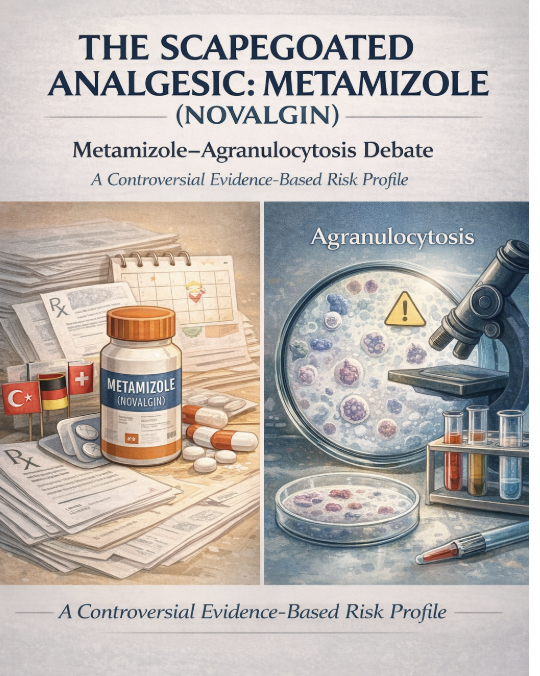
THE SCAPEGOATED ANALGESIC: METAMIZOLE (NOVALGIN)
Metamizole (dipyrone) is an analgesic and antipyretic drug that has been widely used for many decades in numerous countries. However, since the 1970s, the alleged association between metamizole and agranulocytosis has given rise to intense debate regarding its safety profile (14). Agranulocytosis is a rare but potentially life-threatening adverse effect, and the reported risk estimates vary markedly between countries. In this section, the relationship between metamizole and agranulocytosis is examined in a comprehensive manner, integrating historical developments, epidemiological data, and country-specific findings (1,5,14).
The History of Metamizole-Associated Agranulocytosis: The History of a Pharmacovigilance Misinterpretation
The debate on metamizole-associated agranulocytosis emerged several decades after the drug had entered clinical use. Although metamizole (dipyrone) has been widely used as an analgesic and antipyretic since the 1920s, early medical literature does not reveal a clear signal of drug-specific severe hematological toxicity. Initial scientific concerns arose not specifically from metamizole itself, but from observations linking agranulocytosis to pyrazolone derivatives as a pharmacological class (8,16).
During the 1930s, publications focusing primarily on aminopyrine (amidopyrine) played a pivotal role in shaping the concept of analgesic-induced agranulocytosis. Among the most influential publications of this era is the study by Madison and Squier, published in 1934. This report is widely regarded as the first strong clinical evidence demonstrating that drugs belonging to the aminopyrine/metamizole group could induce agranulocytosis. The authors documented sudden and profound leukocyte depletion in 13 patients following the use of aminopyrine and related pyrazolone derivatives, thereby suggesting that so-called “primary granulocytopenia” could, in fact, be drug-induced (17). Kracke’s 1935 article in JAMA is also considered one of the earliest systematic evaluations of the association between pyrazolone derivatives and agranulocytosis (17). During this period, metamizole was assessed within the same pharmacological category as aminopyrine, and the potential risk was largely interpreted as a presumed class effect.
Reports specifically implicating metamizole in agranulocytosis emerged mainly during the 1950s and 1960s, primarily in the form of isolated case reports. These early reports were generally based on single cases and frequently involved confounding factors such as concurrent infections, polypharmacy, and underlying medical conditions. Nevertheless, even in countries where metamizole was widely used, the absolute number of reported cases remained remarkably low (1,6).
The controversy surrounding metamizole-associated agranulocytosis gained substantial momentum in the 1970s following reports from Sweden. A limited number of case reports and pharmacovigilance assessments published between 1973 and 1974 were interpreted as indicating a potentially high relative risk of agranulocytosis associated with metamizole use, ultimately leading to the drug’s ban in Sweden in 1974 (8). Subsequent reassessments, however, demonstrated that these regulatory decisions were based on datasets characterized by very small case numbers, poorly defined exposure denominators, and a failure to adequately consider absolute risk.
In the 1980s, the International Agranulocytosis and Aplastic Anemia Study (IAAAS) represented the first large-scale, multicenter epidemiological effort to evaluate the relationship between agranulocytosis and analgesics, including metamizole. Although some centers reported an increased risk associated with metamizole, the results were highly heterogeneous across countries (3,4). This heterogeneity highlighted the scientific limitations of extrapolating signals from individual countries to universal regulatory decisions.
From the 1990s onward, modern pharmacovigilance and cohort studies conducted in Germany, Switzerland, Spain, and several Latin American countries have consistently shown that metamizole-associated agranulocytosis is a rare but monitorable adverse event. These studies indicate that the absolute risk is low and that, with controlled use, the risk remains manageable (1,5,9–11). The fact that metamizole is an off-patent drug and therefore has not been subjected to the extensive post-marketing phase IV safety programs commonly required for newer analgesics has contributed to the long-term shaping of its risk profile based on early, limited signals rather than systematic prospective data (14).
Epidemiology (The Controversial Safety Narrative of a Highly Effective Drug)
The epidemiological evaluation of the association between metamizole and agranulocytosis clearly illustrates the methodological challenges inherent in interpreting rare adverse events using pharmacovigilance data (9,11). The incidence of agranulocytosis in the general population is extremely low, typically reported as 1–5 cases per million person-years. This rarity makes both statistical estimation and clinical interpretation of drug-attributable risk inherently difficult (5–7).
In the international literature, the absolute risk of metamizole-associated agranulocytosis is generally reported to be approximately 0.2–1.0 cases per million person-years. Nevertheless, some studies have reported elevated relative risks, often derived from small case numbers and poorly defined exposure denominators. In case–control studies in particular, precise information on exposure duration and dosage has frequently been unavailable, and in countries with widespread over-the-counter use, the true exposed population has often not been captured in risk calculations (1,2,5).
Although the IAAAS remains one of the most comprehensive multicenter studies conducted to date, its findings were strikingly heterogeneous across participating countries. While some centers observed statistically significant associations between metamizole use and agranulocytosis, others did not detect a similar signal. This inconsistency underscores the scientific limitations of generalizing findings from individual national datasets (3,4,7).
Another critical issue often overlooked in epidemiological assessments is the failure to relate the absolute number of reported cases to the total volume of drug consumption. Even in countries where metamizole is used by millions of patients, the number of reported agranulocytosis cases remains exceedingly low, clearly demonstrating the small magnitude of absolute risk. Nevertheless, regulatory decisions have frequently been driven by relative risk estimates rather than absolute risk considerations, resulting in interpretations detached from the broader epidemiological context (1,5,7).
Country-Specific Data
Sweden and the Scandinavian Countries
Sweden represents the country in which the metamizole–agranulocytosis association has been interpreted most restrictively at the regulatory level. The limited number of agranulocytosis cases reported during the 1970s led to the ban of metamizole in 1974. A closer examination of the underlying data reveals very small case numbers, poorly defined exposure denominators, and a lack of adjustment for the extent of over-the-counter use. Subsequent retrospective analyses have demonstrated that high relative risk estimates were not evaluated alongside the extremely low absolute risk, with only a handful of cases reported despite millions of doses consumed. Nevertheless, early Swedish regulatory decisions set a precedent for other countries, leading to the rigid application of the precautionary principle rather than evidence-based risk assessment (8,14).
Similar approaches were adopted in Finland and Norway, where Swedish data were generalized in the absence of robust, country-specific epidemiological studies (9,11).
Bulgaria and Eastern Europe
Bulgaria is among the countries with high metamizole consumption yet low reported agranulocytosis incidence. Long-term national data indicate that despite millions of annual doses, only a very limited number of agranulocytosis cases have been reported. Studies centered in Sofia have estimated the maximum attributable risk to be approximately 0.2–0.5 cases per million person-years. These findings suggest that widespread use has not translated into a clinically meaningful public health problem.
A similar pattern is observed across other Eastern European countries, where metamizole continues to be widely used for acute pain and fever, and agranulocytosis is reported as a rare, sporadic adverse event. These data argue strongly against the notion that a universal ban is scientifically justified.
Spain
In Spain, the metamizole–agranulocytosis association has been primarily debated based on case–control studies conducted in the Barcelona region. Although these studies reported elevated relative risks, the clustering of cases within specific centers raised concerns about selection bias. Moreover, when national metamizole consumption data are considered, the absolute number of reported cases remains very low, highlighting the methodological limitations of extrapolating local signals to national policy decisions (2,10).
Latin America
Latin American countries represent regions with some of the highest levels of metamizole use worldwide. Multicenter studies conducted in Mexico, Argentina, and Brazil have consistently shown low agranulocytosis incidence and have failed to establish a strong causal relationship with metamizole. Despite millions of patient-years of exposure, reported case numbers remain limited, reinforcing the conclusion that absolute risk is low (11). These findings support a balanced evaluation of clinical benefit versus rare serious adverse events.
Germany and Switzerland
Modern pharmacovigilance and cohort studies in Germany and Switzerland indicate that metamizole-associated agranulocytosis is rare but warrants monitoring. Reported incidence rates generally range between 0.6 and 1.0 cases per million person-years. With appropriate hematological surveillance and rational prescribing, the risk is considered manageable. Consequently, metamizole continues to be widely used in hospital practice as a potent non-opioid analgesic, with controlled use favored over prohibition (12,13).
Türkiye
Türkiye is a country where metamizole has been widely used for many decades, yet systematic national data on agranulocytosis incidence remain limited. Although metamizole has historically been available both by prescription and over the counter, Turkish publications report only a very small number of agranulocytosis cases potentially attributable to the drug, most of which are limited to case reports (14).
Existing Turkish data indicate that most reported cases involve confounding factors such as polypharmacy, concurrent infections, or underlying hematological disorders, complicating causal attribution. Furthermore, the voluntary nature of pharmacovigilance reporting likely contributes to under- or inconsistent reporting.
Despite widespread long-term use, Türkiye has not experienced an agranulocytosis burden comparable to that reported in some European countries. This observation may reflect genetic factors, usage patterns, dosing practices, or reporting differences; however, definitive conclusions cannot be drawn due to data limitations. Nevertheless, the Turkish experience aligns with international evidence indicating a low absolute risk.
The primary issue in Türkiye is not whether metamizole should be banned, but rather the absence of well-designed national epidemiological studies. Given the drug’s extensive use, Türkiye is well positioned to contribute meaningful data to the global debate, a potential that has thus far remained underutilized (14).
Discussion
The relationship between metamizole and agranulocytosis represents one of the most controversial and frequently misinterpreted topics in the history of pharmacovigilance. The available literature clearly demonstrates that this association cannot be explained by a simple, linear risk model applicable to all countries. Nevertheless, regulatory decisions made in the 1970s and 1980s were often based on limited case series, incomplete exposure data, and methodologically weak signal analyses. In Sweden and certain Scandinavian countries, a small number of reported cases led to high relative risk estimates, while the extremely low absolute risk was systematically overlooked (1,5).
This scenario exemplifies how reliance on relative risk without contextualizing absolute risk can be profoundly misleading when evaluating rare adverse events. In many studies, the emphasis on “risk increase” overshadowed the reality that only a handful of cases occurred among millions of exposed patients. From a public health perspective, absolute risk is the decisive parameter.
Although the IAAAS aimed to clarify the relationship between analgesics and agranulocytosis, its heterogeneous findings further underscore the importance of genetic susceptibility, drug utilization patterns, dosing, treatment duration, and reporting practices. This heterogeneity strongly argues against basing universal regulatory decisions on isolated national signals.
Another critical aspect of the metamizole debate is its off-patent status. Despite being manufactured for many years by Hoechst and later Aventis, metamizole was never subjected to the extensive post-marketing safety programs commonly required for newer, patented analgesics. This lack of large-scale prospective safety data allowed early, limited signals to disproportionately shape the drug’s long-term risk perception, while competing patented analgesics benefited from more robust and better-funded safety datasets.
This asymmetry in evidence generation has also influenced regulatory decision-making. A rare but dramatic adverse effect associated with an inexpensive, off-patent drug proved difficult to defend, whereas competing agents with similar or greater risks but stronger safety dossiers continued to be widely prescribed. Consequently, the prohibition of metamizole in certain countries cannot be interpreted solely as a scientific outcome; political and economic dynamics must also be considered.
The Turkish experience adds a further dimension to this debate. Despite decades of widespread use, Türkiye has not faced a significant public health crisis related to metamizole-associated agranulocytosis. This observation suggests either that the true risk is low or that existing surveillance systems have failed to capture all cases. In either scenario, it demonstrates that regulatory decisions based on external data cannot be automatically generalized to countries with different usage patterns.
Clinically, metamizole exhibits analgesic efficacy that surpasses many non-opioid analgesics and, in some settings, approaches that of opioids. Its effectiveness in visceral and postoperative pain, without the risks of respiratory depression or dependence, positions metamizole as a uniquely valuable analgesic (15,16). Unfortunately, the agranulocytosis debate has often overshadowed this clinical value.
Taken together, the evidence indicates that the metamizole–agranulocytosis relationship is irreducibly complex and has not been adequately considered in regulatory and political decision-making. Metamizole stands as a paradigmatic example of how pharmacovigilance data can be misinterpreted when rare risks eclipse widespread clinical benefit (1,5,14).
Conclusion
The association between metamizole and agranulocytosis should be addressed with caution as a rare but potentially serious adverse effect. However, current epidemiological evidence demonstrates that the absolute risk is low and varies considerably between countries. Regulatory decisions and clinical practice should be guided by robust, country-specific data rather than generalized assumptions derived from limited and heterogeneous sources. With appropriate patient selection and rational use, metamizole remains a valuable component of modern analgesic therapy.
References
- Hedenmalm K, Spigset O. Agranulocytosis and other blood dyscrasias associated with dipyrone (metamizole). Eur J Clin Pharmacol. 2002;58:265–274.
- Ibáñez L, Vidal X, Ballarín E, Laporte JR. Agranulocytosis associated with dipyrone (metamizole). Eur J Clin Pharmacol. 2005;60:821–829.
- International Agranulocytosis and Aplastic Anemia Study (IAAAS). Risks of agranulocytosis and aplastic anemia in relation to the use of analgesics. Eur J Clin Pharmacol. 1986;30:135–143.
- Kaufman DW, Kelly JP, Issaragrisil S, et al. Relative incidence of agranulocytosis and aplastic anemia. Am J Hematol. 1991;36:197–204.
- Andersohn F, Konzen C, Garbe E. Systematic review: agranulocytosis induced by nonchemotherapy drugs. Ann Intern Med. 2007;146:657–665.
- Levy M, Shear NH. Drug-induced agranulocytosis. Drug Saf. 1991;6:165–175.
- Strom BL, Carson JL, Schinnar R, et al. Descriptive epidemiology of agranulocytosis. Arch Intern Med. 1992;152:1475–1480.
- Böttiger LE, Westerholm B. Drug-induced blood dyscrasias in Sweden. Br Med J. 1973;3:339–343.
- Stojanovska L, et al. Metamizole-associated agranulocytosis in Bulgaria: a population-based study. Pharmacoepidemiol Drug Saf. 2014;23:973–979.
- García-Martínez E, et al. Agranulocytosis and dipyrone in Spain: a case–control study. Br J Clin Pharmacol. 2016;82:105–114.
- LATIN Study Group. Agranulocytosis and aplastic anemia in Latin America. Eur J Clin Pharmacol. 1999;55:123–130.
- Federal Institute for Drugs and Medical Devices (BfArM). Metamizole safety assessment reports. Germany.
- Swissmedic. Pharmacovigilance data on metamizole. Switzerland.
- Laporte JR. Metamizole: clinical use and regulatory history. Drug Saf. 2010;33:181–189.
- Moore RA, et al. Single dose oral analgesics for acute postoperative pain. Cochrane Database Syst Rev. 2015.
- McQuay HJ, Moore RA. An evidence-based resource for pain relief. Oxford University Press. 1998.
- Madison FW, Squier TL. The etiology of primary granulocytopenia (agranulocytosis): The recent dramatic increase in incidence of primary granulocytopenia. JAMA. 1934;102(10):755–759.
AI assistance was used in the preparation of this article (especially the references).