







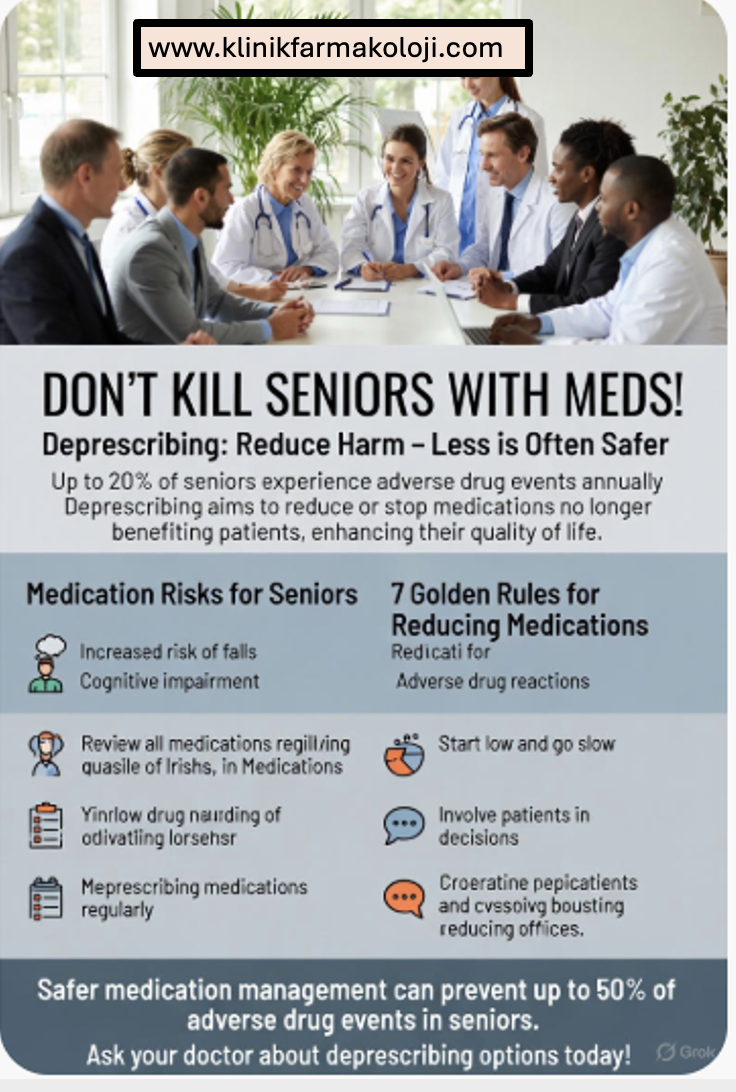
What Is Deprescribing (Medication De-Prescribing)?
Since the term “deprescribing” has not yet entered the Turkish medical literature or pharmacology education, I propose four possible Turkish equivalents: “İlaçsızlaştırma” (De-medication), “İlaç Arındırımı” (Medication Cleansing), “İlaç Ayıklama” (Medication Filtering), and “Tedavi Sadeleştirme” (Therapeutic Simplification).
In this article, I will use the term “İlaç Arındırımı” (Medication Cleansing).
This proposal is open to all suggestions.
A similar example occurred previously with the term bioavailability, which I first translated into Turkish as “biyolojik yararlanım”, later refined by Prof. Dr. Oğuz Kayaalp into “biyoyararlanım”, which then entered the formal Turkish medical lexicon.
Deprescribing as an Emerging Priority in Modern Medicine
Medication cleansing is becoming an increasingly important component of modern clinical practice, yet it is almost never discussed in Turkey. For decades, health systems around the world have treated “adding more medication” as a default step in care. However, aging populations, multimorbidity, multiple prescribers, and a “one more drug won’t hurt” culture have transformed polypharmacy into a major public health problem.
Today, a large proportion of adults over 65 take 6–12 medications daily. Many of these drugs no longer provide benefit, some cause harm, and for many the original indication has long disappeared. Therefore, deprescribing is a preventive, risk-reducing, quality-of-life–oriented strategy, not simply the removal of drugs but a structural correction of irrational medication burden.
Medication Count, Mortality, and Adverse Drug Events in Adults Over 65
Robust cohort studies and meta-analyses show that as the number of medications increases, both mortality and adverse drug event (ADE) risk rise sharply.
Key findings from international research include:
- Polypharmacy (≥5 drugs) is associated with a ~25% increase in all-cause mortality and hospitalization among older adults.
- In a study of healthy, community-dwelling older men, each additional medication was associated with a 22% increase in mortality risk.
- Systematic reviews confirm that increasing medication count is consistently linked with higher mortality in older adults.
- ADE risk increases dramatically with medication count:
- 2 medications → ~15% risk
- 5 medications → ~58% risk
- ≥7 medications → up to 82%
- According to the Lown Institute, each additional drug increases the risk of serious ADEs by 7–10%, and adults ≥65 taking ≥5 drugs have 88% more ADEs than those taking 1–2 drugs.
- In some studies, each newly added drug increased in-hospital adverse drug reactions by 10%.
This evidence shows that every additional prescription in an older adult represents not only theoretical benefit but quantifiable additional risk of death and harm. Deprescribing is therefore not merely a good idea; it is a protective medical strategy.
Deprescribing Does Not Mean “Stopping All Medications”
The goal is not to leave patients “drug-free,” but to discontinue drugs that no longer align with the patient’s health goals, provide minimal benefit, or cause more harm than good.
Many national guidelines—especially from Australia, Canada, and the Netherlands—now treat deprescribing as part of standard care. “What should we add?” is increasingly replaced by “What can we safely remove?”
Definition and Clinical Rationale
Deprescribing is a planned, supervised, evidence-based reduction or discontinuation of medications that are unnecessary, ineffective, risky, or no longer clinically appropriate. It is especially critical in:
- Polypharmacy
- Frail older adults
- Multimorbidity
- High-risk drug classes
- Potentially inappropriate medications (PIMs)
- Drug–drug and drug–disease interactions
The goals include reducing medication burden, minimizing adverse effects (sedation, falls, delirium, QT prolongation), reducing interactions, improving adherence, enhancing quality of life, and lowering healthcare costs.
Deprescribing is not arbitrary drug discontinuation; it is a structured clinical decision requiring re-evaluation of indication, benefit, risk, and interactions.
Medication Classes Commonly Targeted for Deprescribing
- Benzodiazepines
- Z-hypnotics
- Proton pump inhibitors (PPIs)
- Antipsychotics (especially for behavioral symptoms of dementia)
- Anticholinergic medications
- Opioids
- Statins in very old adults or limited life expectancy
- Intensive glycemic control medications (e.g., sulfonylureas)
These drugs frequently cause sedation, falls, cognitive impairment, hypoglycemia, and other serious harms. In frail older adults, long-term preventive benefits are often clinically irrelevant.
The Deprescribing Process
- Comprehensive medication review
Assess indication, duration, adverse effects, interactions. - Risk–benefit re-evaluation
Determine whether actual benefit persists or harms outweigh benefit. - Shared decision-making
Align deprescribing with patient goals, values, fears, expectations. - Tapering plan when necessary
Especially for benzodiazepines, antidepressants, antipsychotics, opioids, some antihypertensives. - Monitoring and follow-up
Watch for withdrawal symptoms, symptom recurrence, vital signs, lab parameters. - Reversal if necessary
Medications may be restarted if clinically required. - Decision-Support Tools
Multiple tools assist clinicians:
- Beers Criteria (American Geriatrics Society)
- STOPP/START Criteria
- MedStopper
- Deprescribing.org algorithms
These are not automatic discontinuation tools but structured guides for identifying and prioritizing medications.
Australian Deprescribing Guideline (2025)
One of the most comprehensive documents globally:
- 185 recommendations
- 70 good practice statements
- Covers >30 drug classes
- Developed through multidisciplinary consensus
Key deprescribing triggers include polypharmacy, ADEs, falls, cognitive decline, organ dysfunction, shifting care goals (e.g., toward palliative care), end-of-life, or loss of indication.
The guideline emphasizes:
- Patient-centered care
- Shared decision-making
- Quality of life over aggressive disease control in frail older adults
Evidence shows deprescribing does not increase mortality; instead it reduces falls, ADEs, hospitalizations, and improves cognition, adherence, and quality of life.
Clinical Examples of Deprescribing
1) Long-term PPI Use Discontinued in 8 Weeks
Evidence:
- Typical taper: 4–12 weeks
- 40–60% of long-term PPI users can discontinue fully
- 40–65% of chronic PPI use is without indication
Guidelines:
- deprescribing.org (Canada)
- NICE (UK)
- Choosing Wisely (US/Australia)
2) Benzodiazepine Deprescribing in Older Adults
Evidence:
- Fall risk ↑ 1.5–2 times
- Long-term use → cognitive decline and dependence
- Tapering success: 50–70%
- CBT-I + tapering improves outcomes
Guidelines:
- Canadian BZRA Deprescribing Guideline
- AGS Beers Criteria
- NICE recommendations
3) Antihypertensive Deprescribing in Frail Older Adults
Frailty criteria (Fried):
Weight loss, slow gait, weak grip strength, exhaustion, low activity.
Frail adults have:
- Higher sensitivity to adverse effects
- Poor tolerance of drug burden
- High fall/delirium risk from overtreatment
Evidence:
- SBP <120 mmHg increases falls/syncope in frail adults
- Deprescribing does not significantly destabilize BP
- Aggressive BP control harmful ≥80 years
Guidelines:
- Australian Deprescribing Guideline
- NICE
- ESC/ESH
4) Statin Discontinuation in Very Old Adults
Evidence:
- Primary prevention benefit appears after 5–10 years
- Often irrelevant in adults 80–90+
- Stopping statins improves quality of life and reduces muscle symptoms
Guidelines:
- Choosing Wisely
- Canadian Deprescribing Network
- NICE: individualized decisions ≥85 years
5) Sulfonylurea/Intensive Diabetes Treatment Deprescribing
Evidence:
- Sulfonylureas → major hypoglycemia in older adults
- Tight control (HbA1c ≈6.0) harmful in frail elders
- Simplifying therapy reduces hypoglycemia and improves function
Guidelines:
- ADA: HbA1c 7.5–8.5% for frail adults
- Canadian Deprescribing Guideline
- NICE: relax targets in multimorbid older adults
6) Anticholinergic Burden Reduction
Evidence:
- Higher ACB score → increased falls, cognitive decline, mortality
- ACB ≥3 → 2–3× higher risk of serious adverse effects
- Deprescribing improves cognition
Guidelines:
- Beers Criteria
- STOPP/START
- Australian Deprescribing Guideline
7) Discontinuing Unnecessary Vitamins and Supplements
Evidence:
- Multivitamins, antioxidants, herbal products rarely show benefit
- No improvement in falls, mortality, or quality of life
- 30–60% of supplement use is without indication
Guidelines:
- Choosing Wisely
- NICE
- Canadian Deprescribing Network
Key International Resources
- https://abimfoundation.org/what-we-do/choosing-wisely
- https://www.deprescribingnetwork.ca/
- https://www.australiandeprescribingnetwork.com.au/940-2/
- https://www.nice.org.uk/guidance
- https://www.escardio.org/Guidelines
- https://www.americangeriatrics.org/media-center/news/many-older-adults-take-multiple-medications-updated-ags-beers-criteriar-will-help
- https://professional.diabetes.org/standards-of-care/practice-guidelines-resources
- https://psnet.ahrq.gov/issue/stoppstart-criteria-potentially-inappropriate-prescribing-older-people-version-3